Biology
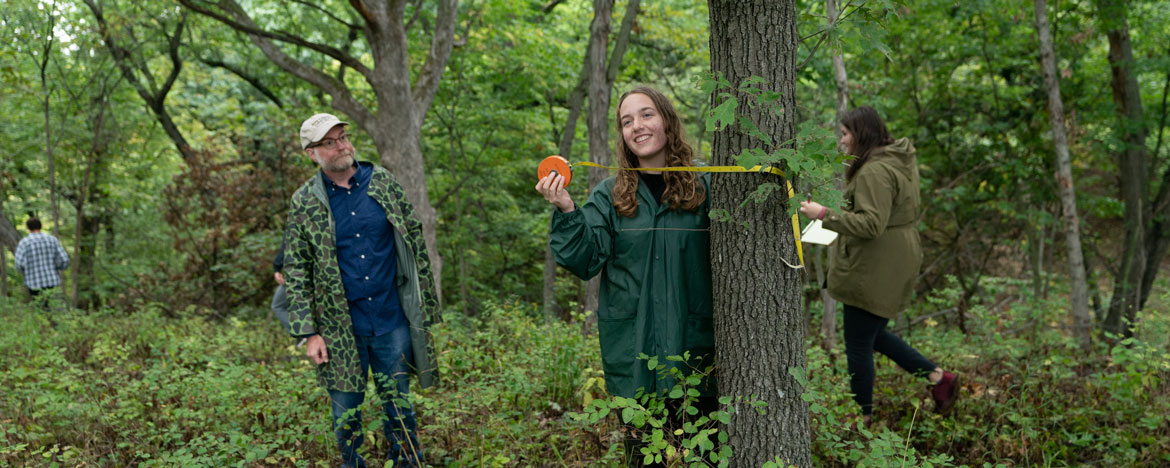
Hands-on learning and research — in the classroom, through field opportunities and via one-on-one mentorships — is how Central College's biology department will help you stand out. You'll gain significant experience using state-of-the-art laboratories and equipment in Vermeer Science Center and at our 80-acre Carlson-Kuyper Field Station, strengthening your resume for future employers and graduate or professional programs.
As a biology major at Central, you'll benefit from many sought-after internships and research opportunities alongside expert faculty — some as early as your sophomore year. Or take advantage of in-depth, hands-on experiences within a range of healthcare fields. Central students find this type of early participation contributes greatly to making them top candidates for prospective employers and graduate programs.
The Central Difference
Play a Role in Changing the World
We face enormous global problems — and expanding opportunities — especially in the areas of social, medical and environmental issues. Biologists have an important role to play, individually and as team members. Discover the many ways you, as a Central biology major, can make a positive impact on the future of humankind and our planet. At Central, we'll help prepare you for an extraordinary life of professional achievement and personal satisfaction.

Make Valuable Professional Connections
You’ll have countless opportunities to learn and meet leaders in the health field through the Heartland Global Health Consortium. Central is a founding member of the consortium, which consists of 10 Iowa-based institutions, collaborating on educational and research opportunities in global health.
Take Advantage of Rare Research Opportunities
You’ll conduct hands-on research with Central faculty members and others to gain early and significant experience in all levels of research, from hypothesis building to data analysis and communicating results at scientific meetings.
During summer breaks, the Arthur J. Bosch Endowment for Student Research supports collaborative research projects with faculty and alumni, including topics like the impact of drought on prairie plants and the distribution of the endangered Indiana bat.
It’s experiences like these that take your college career to the next level — and get the attention of employers and graduate schools.
Learn in Nationally Recognized Facilities
Feel confident you are immersed in a progressive community. Central’s Vermeer Science Center was awarded the silver Leadership in Energy and Environmental Design (LEED) rating from the United States Green Building Council, the first LEED-rated building in the state. Students have direct access to classrooms and laboratories equipped with state-of-the-art instrumentation and presentation technology. Additionally, several parks and wildlife areas are within 10 minutes of campus, including Lake Red Rock, Iowa’s largest lake.
Off-Campus Experiences
Central students can study off-campus — both internationally or domestically in the United States. These opportunities give students the chance to prepare to be global citizens, equipped to compete in the global job market. Students can check out experiences led by Central faculty or attend select academic programs across the world that provide opportunities for study, service, internships and other types of experiential learning. Options include experiences in Chicago, Washington, D.C., Central America, Ghana, England, the Scottish Highlands and more.
Biology majors also have the chance to explore the tropic ecology of Central America with Central faculty.
Beyond Central
Putting the “Hire” in Higher Education
- Annah Bender ’23, Biological Technician, United States Fish and Wildlife Services
- Kaylie Kaller ’22, Quality Control Analyst, Frontier Co-op
- Alexis Engen ’21, Quality Control Specialist, Exile Brewing Company
- Tyler Pfaltzgraff ’19, Research Associate, Stine Seed Company
- Tanner Rathje ’18, Assistant Manager of Chemical Processing and Materials Quality Control, Integrated DNA Technologies
- Danny Nguyen ’18, Chemical Technician, Hach Company
- Jessica Butters ’17, Pollinator Conservation Specialist, Prairie Rivers of Iowa RC&D
- Alec Mathews ’17, Dentist, Beattie Family Dentistry
- Brandon Clough ’13, Environmental Analyst, State Hygienic Lab, University of Iowa
- Jacob Forgie ’15, Environmental Specialist, Iowa Dept. of Natural Resources,
- Kyle Freischlag ’14, General Surgeon, University of Iowa Hospitals and Clinics
- Karien Wilson ’12, Psychiatry Physician Assistant, Hennepin Healthcare
- Brianne Nederhoff ’11, Physician Assistant, Cedar Valley Otolaryngology and Facial Reconstructive Surgery
Central College to Host an MLK Day Program
For MLK Day, Central students and faculty created an alternate day of learning that pays respect to the legacy of Martin Luther King Jr.

Organizations
- Bio-Chem Club
- SCATE (Students Concerned About the Environment)
- Tri-Beta (national biological sciences honor society)
- Health Professions Club
- AWARE (Acquiring Wellness and Rural Education)
Graduate Placement
Thanks to rigorous coursework and research opportunities, 92 percent of biology students who applied to graduate school were accepted into a program of their choice.
- Duke University School of Medicine
- University of Iowa, dentistry
- Virginia Commonwealth University, forensic science
- University of Newfoundland, microbiology
- The University of Kansas, pharmaceutical chemistry
- Colorado State University, organic chemistry
- McGill University - Macdonald Campus, agricultural engineering
Internships
Central's biology department equips students for future research with hundreds of internship opportunities, which prepare students for graduate school.
- Neil Smith National Wildlife Refuge
- Nature Conservancy of Iowa
- Mayo Clinic
- Ohio State University Cytogenics Lab
- Northwestern University, Chicago
- National University of Mexico, Yucatan
- Minnesota DNR, St. Paul
- World Food Prize Foundation, Des Moines

Courses & Faculty
Introductory courses such as Introduction to Cells and Diversity of Life lay the foundation for the biology major. In the second year, students begin to explore biology more deeply in ecology and genetics. Both the junior and senior years include research opportunities, seminars and electives in a student’s specific area of interest.
Electives include botany, human anatomy, animal biology, microbiology, tropical ecology, evolutionary medicine, conservation biology, aquatic toxicology and many others.
Learn more about this discipline in the course catalog.
Meet the Faculty
- Russ Benedict, B.A., M.A., Ph.D., Professor of Biology
- Anya Butt, B.A., M.S., Ph.D., Professor of Biology
- Ellen Du Pre, B.S., Ph.D., Professor of Biology
- Lee Macomber, B.S., M.S., Ph.D., Associate Professor of Biology
- Paulina Mena, B.S., Ph.D., Professor of Biology
- Nicole Palenske Ladner, B.S., M.S., Ph.D., Associate Professor of Biology
- Jim Shriver, B.S., M.S., Ph.D., Professor of Chemistry
- Kristin Siewert, B.S., M.S., Senior Lecturer of Biology
- Paul Weihe, B.S., M.S., Ph.D., Associate Professor of Biology
Sample Coursework
First Year
- General Chemistry
- Introduction to Cells
- Organic Chemistry I
- Diversity of Life
Sophomore Year
- Organic Chemistry II
- Principles of Ecology
- Genetics
- Math and computer science requirement
Junior Year
- Math and computer science requirement
- Biology electives
- Off-campus experience
Senior Year
- Biology Seminar
- Evolution
- Biology electives
Learn More
Want to find out more about Biology at Central? Contact us to learn more about this discipline and our other strong academic programs.
Visit campus to observe classes and experience The Central Difference firsthand.
This site is protected by reCAPTCHA and the Google Privacy Policy and Terms of Service apply.